

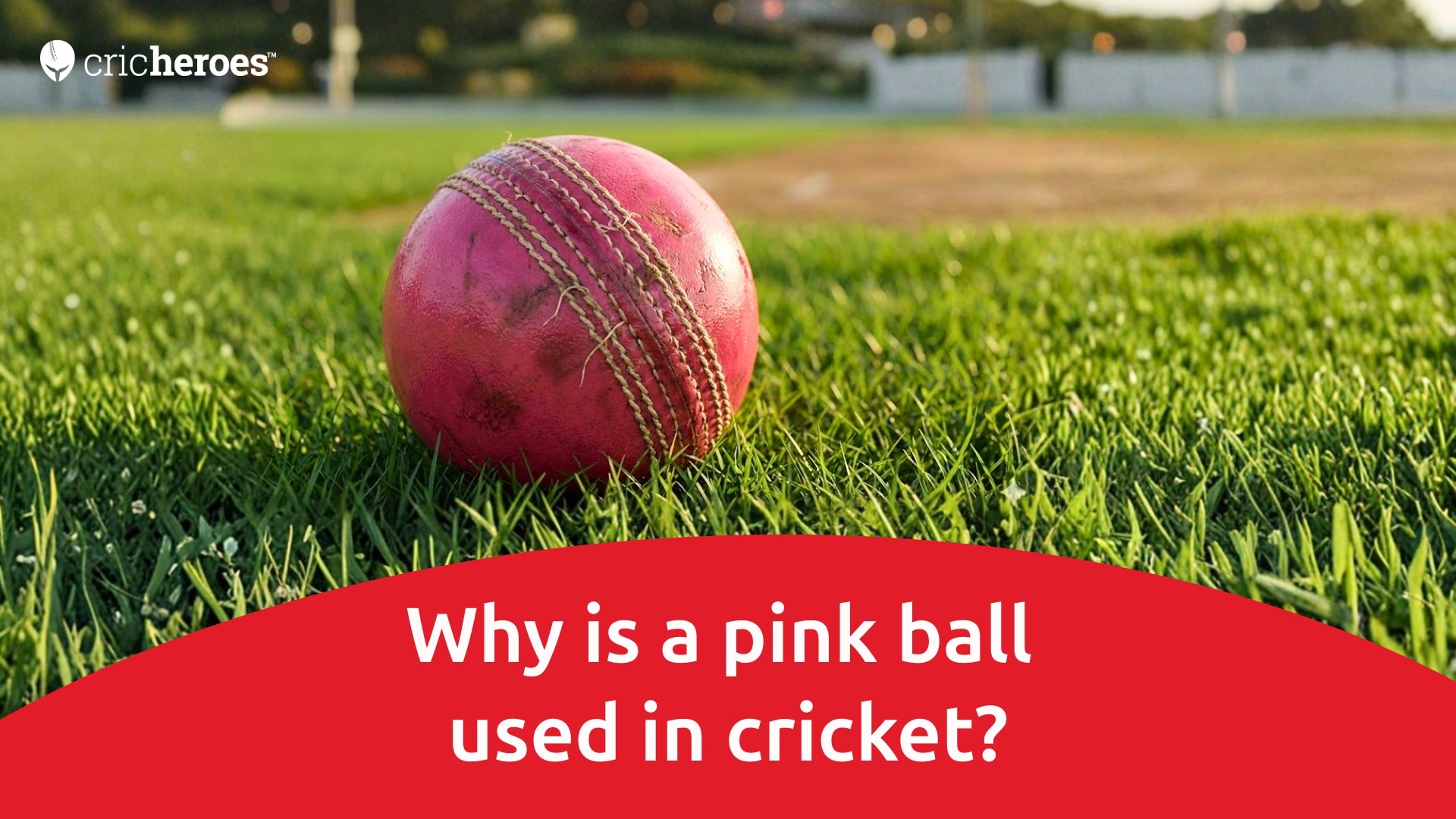


Many players still search for why pink ball is used in cricket, especially during day-night tests. Red balls fade under lights. White balls wear out fast and clash with clothing. Teams needed a colour that stays clear from afternoon to night. Pink solved this need.
This guide explains the full science behind the pink ball, how it is made, how it behaves in tests, and why teams plan different tactics with it. This guide keeps everything simple, steady, and easy for every player and fan.
Quick answer
Why pink ball is used in cricket?
Pink ball is used in cricket because it stays clear under floodlights, works better for TV cameras, lasts longer than white balls, and stays easier to track when red balls start losing colour in the evening.
Why cricket needed a different ball for night Tests
Red ball issue under lights
Red balls start losing colour after long spells. Under stadium lights, the ball often blends with the background. Umpires and slip fielders face trouble tracking it late in the day. Twilight makes this even harder.
White ball issue for Tests
White balls work for ODIs and T20s but not for long sessions. They clash with white clothing. They fade fast and rarely stay firm beyond 30–40 overs. Test cricket needs a ball that lasts close to 80 overs.
Failed colour experiments
Before choosing pink, teams tested:
- Orange balls: clear in daylight but weak on TV.
- Yellow balls: bright at first but blended with dry pitches.
Players struggled to judge both during evening sessions.
Why pink was chosen
Pink stood out across grass, sky, lights, and clothing. It stayed steady on camera and felt easier for umpires and players to track.
Also read: Types of Balls in Cricket
History of the pink ball
Early trials
Women’s matches tested early pink ball models. Domestic teams also used them in training games. These trials helped makers understand movement, swing, and shine.
Sheffield Shield shift
Australia used pink balls in the Sheffield Shield. This offered match data across long spells, helping refine the model.
First men’s Test in 2015
Australia and New Zealand played the first men’s pink ball Test in 2015 at Adelaide.
India’s entry in 2019
India played its first pink ball test in Kolkata in 2019. SG later updated its design based on match feedback.
Growth till 2025
More boards now add day/night tests. Kookaburra, Dukes, SG, and MCC still work on seam life, clarity, and shine durability.
How pink balls are made
Base structure
A pink ball uses the same core as a red ball:
- Cork core
- Strong string winding
- Four-piece leather cover
Key difference: surface finish
This is the main change.
- Red balls use dyed leather with wax.
- Pink balls use painted leather with a thick PU coat.
Why PU coat changes behaviour
The PU coat gives a harder, smoother finish. Because of this:
- Shine lasts longer
- Swing stays for more overs
- The ball stays clear under lights
Seam details
Pink balls often use a black seam. It helps batters and fielders judge rotation and length. Linen blends keep the seam strong.
Why pink colour ball is used in cricket
Visibility under stadium lights
This is the main reason why pink colour ball is used in cricket. Pink stays clear under LED lights. Batters see it earlier, fielders judge depth better, and umpires track seam movement.
Broadcast clarity
Cameras read pink better than red in twilight. This improves viewing quality for fans.
Durability
White balls fade fast. Pink balls often last 40–60 overs. This suits Test match needs.
Match performance
Pink balls swing longer due to the PU coat. Seams stay firm longer. Many batters report sharper movement after sunset.
Why pink ball is used in Test cricket
Test matches run across long sessions. During day/night tests, lighting changes often. Pink helps in these areas:
- Better clarity
- Clearer judgement for umpires
- Stronger visibility for close catchers
- Longer shine life
Teams adjust their bowling spells based on this behavior.
Pink vs red vs white ball
| Feature | Pink | Red | White |
| Visibility | Best at night | Best in day | Good under lights |
| Surface | PU coat | Wax finish | PU coat |
| Durability | Medium | High | Low |
| Swing | Lasts longer | Moderate | Short period |
| Seam | Black | White | White |
Twilight effect on the pink ball
Twilight is the toughest phase of a day-night test. During this short period:
- Temperature drops
- Humidity rises
- Movement increases
- Batters face trouble reading length
Captains often hold fast bowlers for this phase. Many wickets fall in this slot.
Also read: Tape Ball vs Tennis Ball
Why does the pink ball swing more
Pink balls swing more because of:
- Smooth PU surface
- Harder coat
- Taller seam
- Night air helping movement
New balls swing a lot early. Older balls can still move late because shine stays longer.
How the pink ball behaves across countries
Australia
- Ball Type: Uses the Kookaburra ball, which has a less prominent, machine-stitched seam that tends to flatten faster than others.
- Behavior: The Kookaburra pink ball swings prodigiously in the initial overs, especially in the cool, humid twilight period at venues like the Adelaide Oval. Pitches for day-night tests often have extra grass left on them to preserve the ball’s condition, which aids seam movement. The ball tends to skid on the surface due to the extra lacquer, requiring faster reaction times from batters.
- Spin: Spinners generally have a lesser impact in Australia because the seam flattens quickly, making it harder to extract a sharp turn.
England
- Ball Type: Uses the Dukes ball, which is entirely hand-stitched, has a more pronounced seam, and is known to swing for a longer period.
- Behavior: The Duke’s pink ball provides significant seam movement and swing, similar to its red-ball counterpart in English conditions. The cooler temperatures and longer twilight period in the English summer can extend the period where the ball dominates over the bat.
- Spin: Spinners find it difficult to grip the lacquered surface, though the pronounced seam offers more potential for grip compared to the Kookaburra.
India
- Ball Type: Uses the SG ball, which is also fully hand-stitched with a very prominent seam.
- Behavior: On the characteristically dry, abrasive Indian pitches, the pink SG ball is designed to retain its seam and hardness for a long time. This aids both pacers (with reverse swing as the shine wears off) and spinners, who can exploit the pronounced seam for grip and turn. Unlike in Australia, where pacers dominate, quality spinners can be highly effective in India with the pink ball, as demonstrated by Axar Patel’s 11-wicket haul in Ahmedabad in 2021.
- Spin: The SG ball offers great grip for spinners due to its prominent seam, making spin a more potent weapon in pink-ball tests in India than in other countries.
West Indies / Other Kookaburra Nations (e.g., New Zealand, South Africa, Pakistan)
- Ball Type: Uses either the Dukes (West Indies) or Kookaburra (others) pink ball.
- Behavior: The ball behavior is dictated by the manufacturer and local conditions. In the West Indies, the Dukes ball performs as expected with a prolonged swing. In Kookaburra nations, the ball’s behavior generally mirrors Australian conditions, with early swing and less assistance as it ages.
- Overall: Day-night tests in venues like Dubai and New Zealand have seen 400-plus totals, suggesting conditions can sometimes be more batter-friendly than in Australia, depending on the specific pitch preparation.
Challenges of playing with the pink ball
For batters
- Harder to judge seam
- More swing in twilight
- Sharper bounce early
For pace bowlers
- Good swing but smooth surface
- The grip feels different
For spinners
- Less early turn
- More skid
- Need drift, dip, and smart angles
For wicketkeepers
- Faster edges
- Late wobble feels tricky
Why other colours are not used
Tests tried yellow, orange, and blue, but none worked for lights, pitch contrast, or tracking. Pink stayed the best option.
Buy Pink Cricket Leather Balls From CricHeroes Store
If you want to practice with the same type of ball used in day-night matches, you can get match-ready pink cricket leather balls from the CricHeroes Store. These balls go through strict quality checks for seam strength, shine life, and roundness. Players, coaches, and academies use them for nets, match prep, and longer spells under lights.
Summary
Pink balls helped cricket shift into night test matches. They stay clear under lights, last longer than white balls, and move more because of the PU coat. Teams plan spells around twilight, and batters adjust timing for sharper movement.
Your cricket matters, and understanding the pink ball helps every player plan better.
FAQs
Why pink ball is used in Test cricket?
Teams use a pink ball in Test cricket because it stays easier to see under lights and keeps its swing for longer spells.
Why pink colour ball is used instead of red?
They choose pink over red because the red ball loses its color under lights and becomes hard for players to track.
Why does the pink ball swing more?
Pink ball swings more because its PU coat keeps its shine for more overs.
Why does the pink ball feel harder?
Pink ball feels harder due to the painted leather and the PU finish.
Why can’t Tests use white balls?
Tests cannot use white balls because they clash with clothing and fade fast.
Why does the pink ball lose colour after long spells?
Pink balls lose colour when the coat wears off on rough surfaces.
Is the pink ball heavier than red?
No, both follow the same weight rules.
Why do spinners struggle with the pink ball?
Spinners struggle because the PU coat reduces early turn.
Does the pink ball reverse swing?
Yes, it can reverse swing once the coat wears down.

I am Manan Joshi , SEO All-Rounder at CricHeroes.
CricHeroes is the ultimate Cricket Scoring App and the world’s only true Cricket Network. With more than 4 crore+ registered cricketers using CricHeroes to Live Cricket Scores for their local cricket matches and tournaments, CricHeroes is already the #1 Cricket Scoring App Globally!
We also proudly present “CricHeroes Store” by CricHeroes, a dedicated shop for cricket apparel and accessories, helping players gear up for their game.