

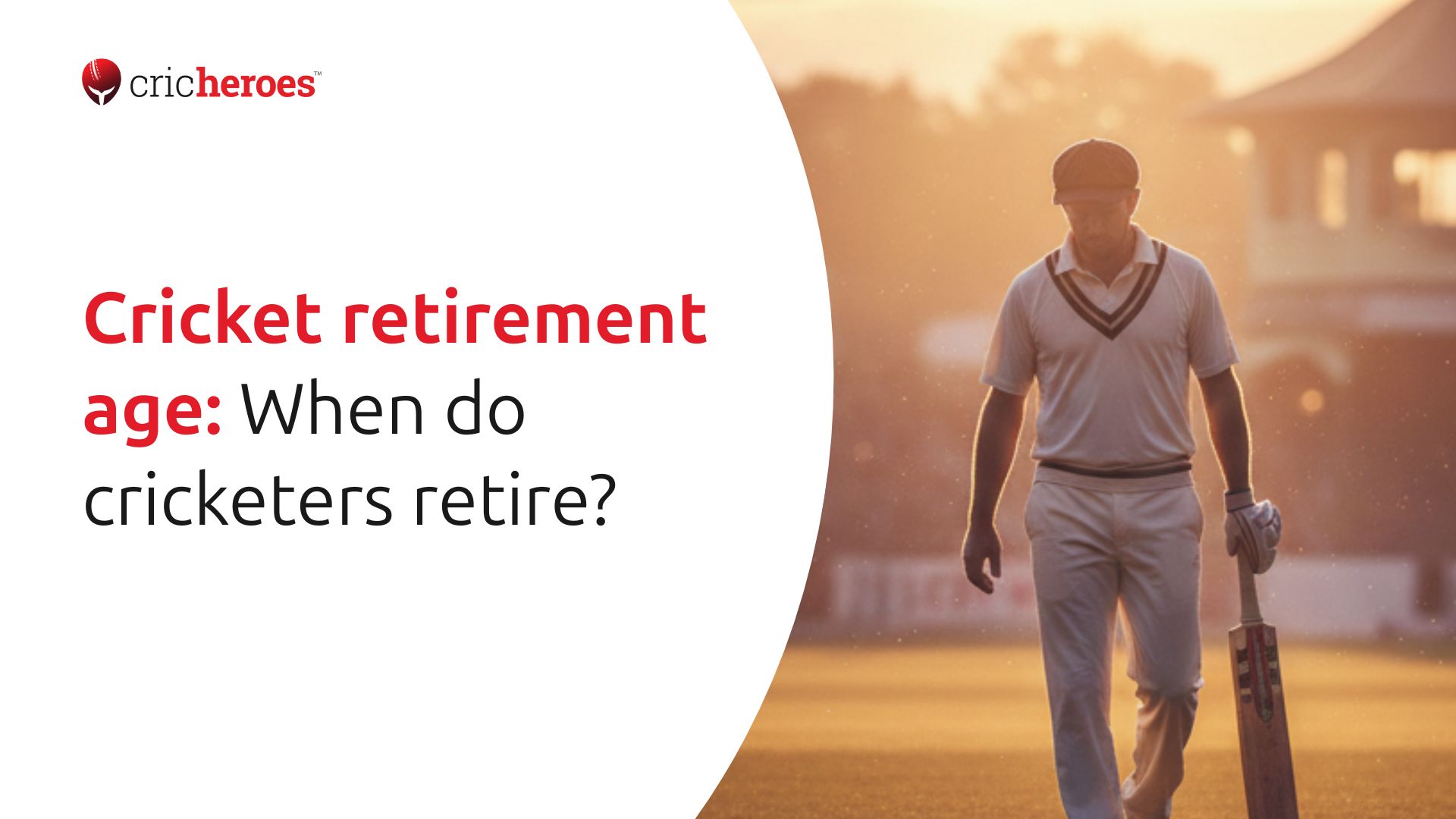


Cricket fans often ask one question: what is the cricket retirement age? While some players like MS Dhoni retired in their late 30s, others such as James Anderson are still playing in their 40s. This shows that the cricket retirement age isn’t fixed. It depends on a player’s form, fitness, and personal goals.
Unlike some other sports, cricket allows flexibility. Players can decide when to step away based on performance and physical condition.
In this blog, we’ll explore the average and maximum retirement ages, India-specific data, format-wise comparisons, and why cricketers retire early or late.
Is there a fixed retirement age in cricket?
Cricket doesn’t have an official retirement age set by the ICC or any national board. Unlike sports such as football or athletics, players are free to decide when they want to retire based on their own performance and fitness.
Some may leave early due to injuries or team selection issues, while others continue for decades if they remain effective.
| Sport | Official Retirement Rule | Cricket Comparison |
| Football | No official age limit, but most retire by 35 | Same – performance-based |
| Tennis | No fixed rule | Same – depends on physical condition |
| Cricket | No official retirement age | Entirely individual choice |
This freedom makes cricket unique, where passion and form, not age, decide a player’s fate.
Score all your matches for free.
From friendly matches to big tournaments, CricHeroes helps you score, livestream, and analyse your game.
Average retirement age of cricketers
By format
| Format | Common Retirement Age | Reason |
| Test | 35–38 years | Physical and mental workload |
| ODI | 33–37 years | Balance between workload and competition |
| T20 | 31–35 years | High intensity and shorter format |
By role
- Fast bowlers usually retire earlier due to physical strain.
- Batsmen tend to continue longer, depending on form.
- Spinners often extend careers into their late 30s.
- Wicketkeepers retire earlier if reflexes decline.
These averages vary depending on domestic leagues, injuries, and national team demands.
Also read: How to become a good cricketer at any age
Maximum age of retirement in cricket
There’s no upper limit. If a player performs well, age doesn’t matter.
Examples include:
- James Anderson – still playing international cricket at 42
- Misbah-ul-Haq – retired at 42
- Brad Hogg – played professional T20s till 46
Here’s a quick look at some of the oldest players to play professional cricket:
| Player | Country | Age at Retirement | Format |
| Brad Hogg | Australia | 46 | T20 |
| Misbah-ul-Haq | Pakistan | 42 | Test |
| James Anderson | England | 42 (active) | Test |
| Sanath Jayasuriya | Sri Lanka | 42 | ODI |
Retirement age in Indian cricket
BCCI’s role and policy
The BCCI doesn’t have any fixed rule for retirement. It’s left to the players. Some retire from one format while continuing in others, a strategy that helps extend their careers.
For example:
- MS Dhoni retired from Tests in 2014 but continued playing ODIs and T20Is till 2020.
- Virat Kohli is focusing on tests in his mid-30s.
Average age of Indian cricketers’ retirement
| Player | Format | Retirement Age |
| MS Dhoni | International | 39 |
| Sachin Tendulkar | International | 40 |
| Virender Sehwag | International | 37 |
| Ashwin | Still active | Late 30s |
On average, Indian cricketers retire between 35–38 years.
Early retirements in India
Some talented players like Suresh Raina, Irfan Pathan, and Gautam Gambhir retired early, either due to selection challenges or to pursue franchise leagues.
Why do cricketers retire?
Physical and mental fatigue
Constant travel, long tours, and the pressure of international cricket can wear players out.
Injuries and fitness
Fast bowlers and all-rounders often retire early because of recurring injuries.
Team selection pressure
Younger talent entering the team pushes senior players to step aside.
Family and personal choices
Many choose to spend more time with family or shift to less demanding leagues.
Money and T20 leagues
The rise of T20 leagues gives players financial stability, prompting some to retire from international formats early.
Test cricket retirement age vs limited overs formats
Why test players retire later
Tests rely on skill, patience, and experience. Older players can thrive here because the format rewards technique over speed.
Why T20 players retire sooner
The T20 format is physically demanding and often forces players to stop earlier due to high intensity.
Players who retired from one format only
- Dhoni retired from Tests first.
- AB de Villiers stopped international cricket but continued in T20 leagues.
This flexibility shows how players balance workload and longevity.
What happens after retirement
Coaching and commentary
Many legends become coaches or commentators.
Examples: Rahul Dravid, Ricky Ponting, and Sunil Gavaskar.
Franchise and domestic leagues
Some continue in leagues like IPL or BBL even after retiring internationally.
Business and media roles
Several former players launch academies or brands or join media as analysts.
Pension and BCCI benefits (India)
Retired Indian players receive pensions and benefits from the BCCI, ensuring long-term security.
Also read: How BCCI earns money
Tips for aspiring cricketers to extend their career
- Focus on fitness and consistency.
- Avoid burnout by resting between tournaments.
- Keep learning new skills to stay relevant.
With proper planning, you can enjoy a long and healthy cricket career no matter your age.
Conclusion
There’s no official retirement age in cricket. It all depends on fitness, performance, and passion. Some players stop early, while others play well into their 40s. What truly matters is how you take care of your body and keep improving your game.
If you’re an active cricketer who wants to track matches, scores, and performance just like professionals, download the CricHeroes App today. It’s the easiest way to score your local games, follow tournaments, and build your cricket journey step by step.
👉 Download the CricHeroes App now and keep your cricket story going — age is just a number!
FAQs
1. What is the retirement age in cricket?
There’s no fixed age. Most players retire between 35 and 38 years old.
2. What is the retirement age in Indian cricket?
Usually 35–38 years, depending on the player’s form and fitness.
3. What is the maximum retirement age in cricket?
Some players have played till their mid-40s if performance allowed.
4. Why do some players retire early?
Injuries, poor form, or personal reasons are the main causes.
5. Can a cricketer play after 40 years age of?
Yes, if they remain fit and are selected. Anderson and Hogg are examples.
6. Do bowlers retire earlier than batsmen?
Usually yes, due to higher physical strain.
7. Is there a difference in retirement age for Tests and T20s?
Yes, T20 players often retire earlier due to its intense nature.

SEO All-Rounder
Manan Joshi is a cricket writer & content strategist at CricHeroes who covers the game from the ground up — rules, technique, player development, grassroots tournaments, and IPL. His writing is shaped by real insights drawn from millions of live-scored matches, giving him a perspective on recreational cricket that few writers have access to. CricHeroes is the #1 Cricket Scoring App globally, with 4 crore+ cricketers using it to live score their local matches and tournaments. For cricket apparel and accessories, visit the CricHeroes Store.