




Every weekend, somewhere on a local ground, a match stops. Not for rain, not for a wicket, but for an argument. A bowler is sure it was a fair ball. The batting side is sure it was a no ball. The umpire, often a player from the next match, isn’t certain either. Voices rise, the over stalls, and a good game loses ten minutes to a rule nobody fully understands.
This happens far more than it should. And almost always, it isn’t because someone is cheating. It’s because grassroots cricket runs on half-remembered rules, dressing-room myths, and “that’s how we’ve always played it.”
This guide fixes that. It walks through the cricket laws that cause the most confusion in local and grassroots cricket, and explains each one in plain language. No legal wording, no lectures. Just the real match situations you keep running into, and what actually happens according to the MCC Laws of Cricket.
Read it once and you’ll settle most on-field disagreements in seconds. Bookmark it, and you’ll have the answer ready the next time someone’s absolutely certain they’re right.
1. The bowler didn’t say which side he’s bowling from
The situation
A bowler walks back to his mark and starts the over. He doesn’t tell anyone whether he’s coming over or round the wicket, and the umpire is busy and doesn’t ask. He bowls. The batting side appeals, claiming it should be a no ball because nothing was announced.
Why players get confused
In a lot of local cricket, players have seen umpires call out “over the wicket” or “round the wicket” before an over. So they assume that announcement is a rule, and that skipping it makes the delivery illegal.
Score all your matches for free.
From friendly matches to big tournaments, CricHeroes helps you score, livestream, and analyse your game.
What most people believe
The myth is simple: the bowler must always inform the umpire of his side before bowling, and if he doesn't, it's a no ball.
What the law actually says
The job of confirming the bowling side belongs to the umpire, not the bowler. Under Law 21.1.1, the umpire asks the bowler at the start of the over which side and which mode he intends to bowl, and then informs the striker. If the umpire forgets to ask, that's an oversight by the umpire. It does not make the delivery a no ball.
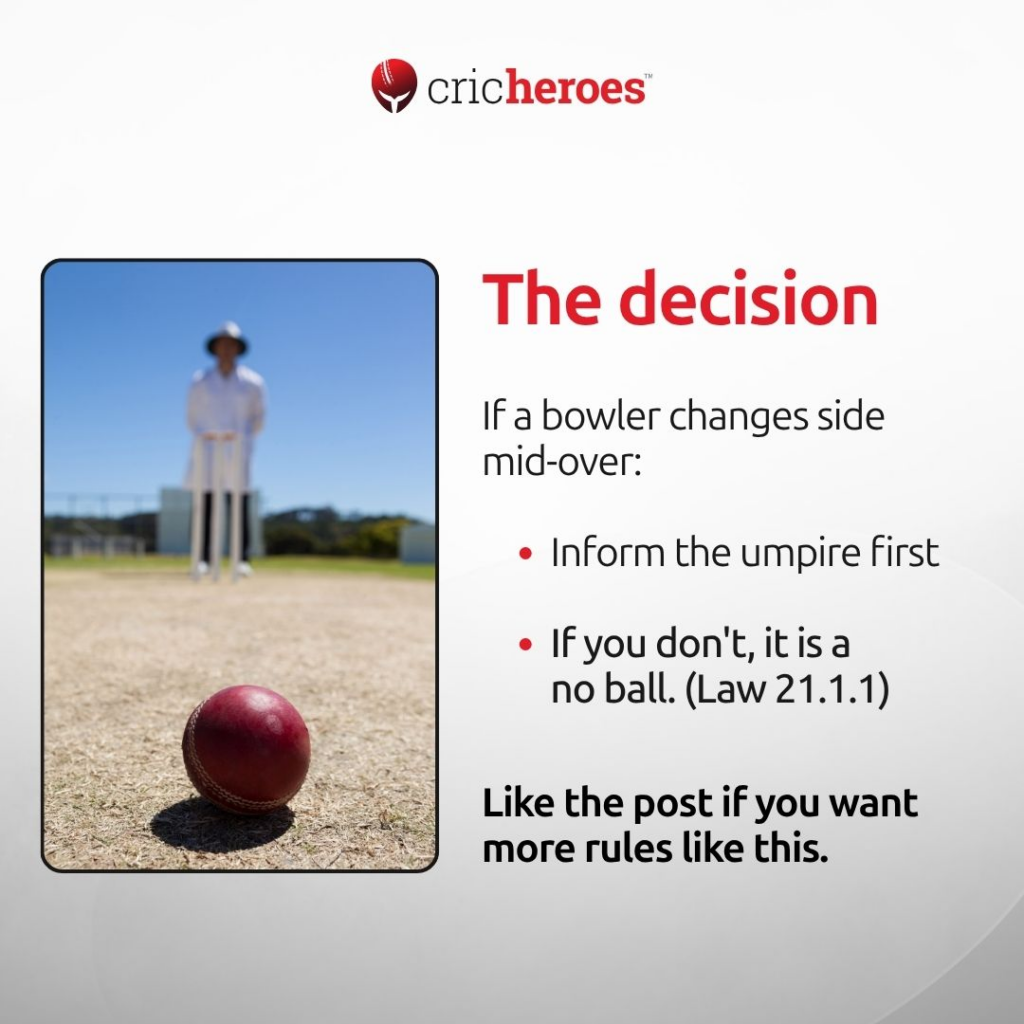
There's a real condition hidden in the same Law, though. The bowler can't switch from over the wicket to round the wicket, or change his mode, in the middle of an over without telling the umpire. If he changes without informing, then it becomes a no ball, again under Law 21.1.1.
Simple example
You start your over bowling over the wicket. Three balls in, you decide to go round the wicket and just do it without a word. That fourth ball is a no ball. But if you bowl a full over from the same side and the umpire never announced anything, every ball is fair.
Final verdict
Not announcing the side is fine. Changing the side mid-over without informing the umpire is the no ball.
2. The keeper moved without telling the umpire
The situation
The wicketkeeper is standing back to a quick bowler. Sensing a slower ball, he quietly creeps right up to the stumps just before the bowler delivers. The batting side notices the sudden change and objects.
Why players get confused
Most players know the keeper "isn't supposed to move," but they're fuzzy on what counts as moving, and on what the penalty actually is. Adjusting your feet is normal. Shuffling sideways with the line of the ball is normal. So where's the line, and is it really a no ball?
What most people believe
The common belief is that a big keeper movement is a no ball. It isn't, and that's the part almost everyone gets wrong.
What the law actually says
Two different keeper situations get mixed up here.
The first is a major change of position, like going from standing back to rushing up to the stumps, after the ball is in play. Small, natural adjustments are fine, but a significant unfair movement is dealt with under Law 27.4, and the penalty is a dead ball. That means the delivery simply doesn't count and is bowled again. There's no run added. So this is not a no ball.
The second is the keeper moving in front of the line of the stumps before the ball reaches the striker. That one is a no ball, under Law 27.3, because the keeper must stay wholly behind the stumps until the ball passes the bat or the batter.
So a keeper creeping up isn't punished with a run, it just gets the ball re-bowled. A keeper standing ahead of the stumps at delivery is the actual no ball.
Simple example
The keeper is standing back. As you load up to bowl, he sprints up to the stumps to try and stump a batter who likes to leave his crease. The umpire can call dead ball and have it bowled again, with no penalty run. But if that keeper is actually positioned in front of the stumps when you deliver, that's a no ball.

Final verdict
Minor adjustments are fine. A big, undeclared change of position is a dead ball and a re-bowl, not a no ball. The keeper standing in front of the stumps at delivery is the real no ball.
3. The back foot touched the return crease
The situation
A bowler delivers, and as his back foot lands, the edge of his boot just kisses the inside line of the return crease, the line that runs along the side. The batting side appeals for a no ball. The bowling side says it was barely touching, so it's fine.
Also read: Cricket Terms Explained: Full A–Z Glossary with Examples
Why players get confused
There's a widespread idea that you only get penalised if your foot lands fully outside the crease, and that a slight touch of the line doesn't count. People treat the line as a generous margin rather than a hard boundary.
What most people believe
The myth: only a full overlap of the line matters, and brushing the line is allowed.
What the law actually says
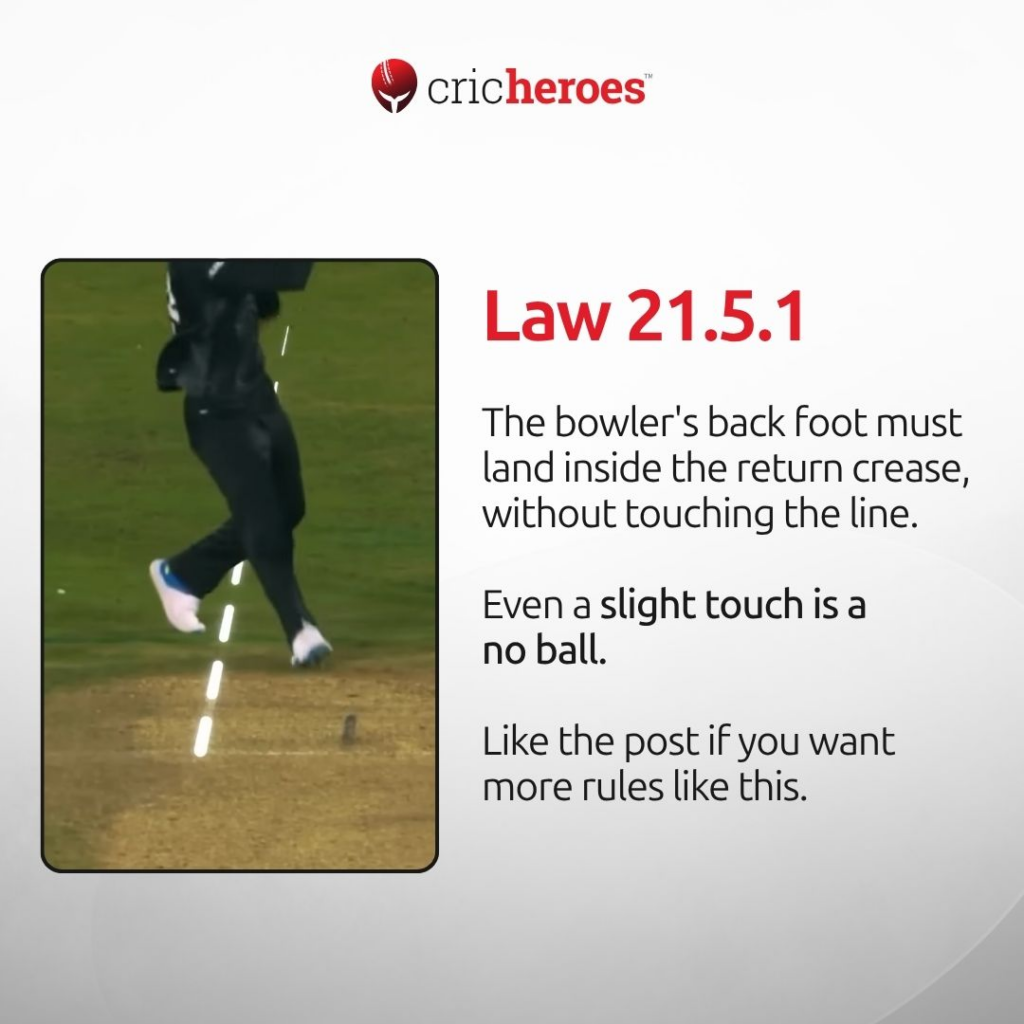
Under Law 21.5.1, the bowler's back foot must land within the return crease and must not touch it. The line itself is out of bounds. So even slight contact with that line makes it a no ball. There's no "close enough" allowance here.
This catches a lot of bowlers who run in wide and angle across the crease, especially round-arm and wide-of-the-crease bowlers.
Simple example
You bowl from very wide on the crease to create an angle. Your back foot lands mostly inside, but the outer edge clips the return crease line. That's a no ball, even though most of your foot was legal.
Final verdict
The back foot must stay inside the return crease. Touching the line, even slightly, is a no ball.
4. A full toss above the waist
The situation
A bowler sends down a full toss. The batter, trying to get to the pitch of it, steps well forward. The ball arrives around chest height where he's now standing. There's confusion over whether it's a no ball, because he moved towards it.
Why players get confused
The waist-high full toss rule is one everyone has heard of, but the detail trips them up. Players assume the height is measured wherever the batter happens to be at the moment of contact. So if he's charged down the pitch, surely a higher ball is okay?
What most people believe
The myth: if the batter moves forward, a high full toss is allowed because he brought himself closer to the ball.
What the law actually says
The call is not based on where the batter has moved to. Under Law 41.7, the judgement is made on where the ball would have passed the batter standing in a normal, upright stance at the popping crease. If, in that position, a full toss would have passed above waist height, it's a no ball, regardless of how far down the pitch the batter has come. The Laws even define waist height for this purpose as roughly where the top of the batter's trousers would sit when he's standing upright at the crease.
This protects the batter. Otherwise a bowler could fire dangerous high full tosses and escape the penalty just because the batter instinctively advanced.
Simple example
A batter charges out to a full toss and it reaches him at shoulder height two metres down the track. The umpire mentally puts the batter back at his crease in his normal stance. Would that same ball have been above his waist there? If yes, it's a no ball.

Final verdict
Height is judged at the batter's normal stance at the crease, not where he moves to. Above the waist there means no ball.
5. How many fielders are allowed on the leg side
The situation
A captain is setting a leg-side trap. He's counting fielders, the bowler decides to go round the wicket, and someone insists the bowler now counts as an extra leg-side fielder. The field gets reshuffled in a panic.
Why players get confused
Two separate things get tangled here: how many fielders can be on the leg side in total, and how many can be behind the popping crease on the leg side. Players also wrongly fold the bowler and keeper into the count.
What most people believe
Two myths show up often. First, that a bowler going round the wicket counts as the sixth leg-side fielder. Second, that any number of fielders can stand behind the popping crease on the leg side.
What the law actually says
The bowler and the wicketkeeper are not counted as leg-side fielders at all. There are two different limits to keep separate.
The universal one, part of the MCC Laws and applying in every format, is Law 28.4: no more than two fielders, other than the keeper, may be behind the popping crease on the leg side at the instant of delivery. Break it and it's a no ball. This is the old "Bodyline" restriction.
The second limit, a maximum of five fielders on the leg side in total, is not an MCC Law. It comes from the limited-overs playing conditions that most leagues and tournaments adopt. So whether the five-fielder cap applies to your match depends on the rules your competition is played under, while the "two behind the popping crease" limit applies everywhere.
The "behind the popping crease" part is the one most local sides forget. Even where you're allowed five on the leg side, you still can't have three of them stationed back behind the crease.
Simple example
You've got a leg slip, a leg gully, a square leg, a mid-wicket and a deep square leg. That's five on the leg side, which is fine. But if leg slip, leg gully and a fine leg are all behind the popping crease, that's three behind the line. One too many, and it's a no ball.

Final verdict
No more than two fielders behind the popping crease on the leg side, everywhere (Law 28.4). The "max five on the leg side" cap is a limited-overs playing condition, not a universal Law. The bowler and keeper don't count.
6. Fielding restrictions when you're short on players
The situation
A team turns up with only nine players. During the powerplay, the captain tries to figure out the fielding restrictions and ends up cramming everyone inside the circle, convinced that's what the rule demands.
Why players get confused
This is one of the most misunderstood rules in grassroots cricket, and it's because people think about it the wrong way round. They focus on how many fielders must be inside the circle. When the team is short, that mental model falls apart and panic sets in.
What most people believe
The myth: if you're playing with nine, you have to put all available fielders inside the circle during the powerplay, and you can't place anyone outside.
What the law actually says
First, the important bit of context: powerplays and the 30-yard circle are not part of the MCC Laws at all. They come from the limited-overs playing conditions your league or tournament adopts, so the exact number of powerplay overs varies from format to format. What stays the same is how the restriction works.
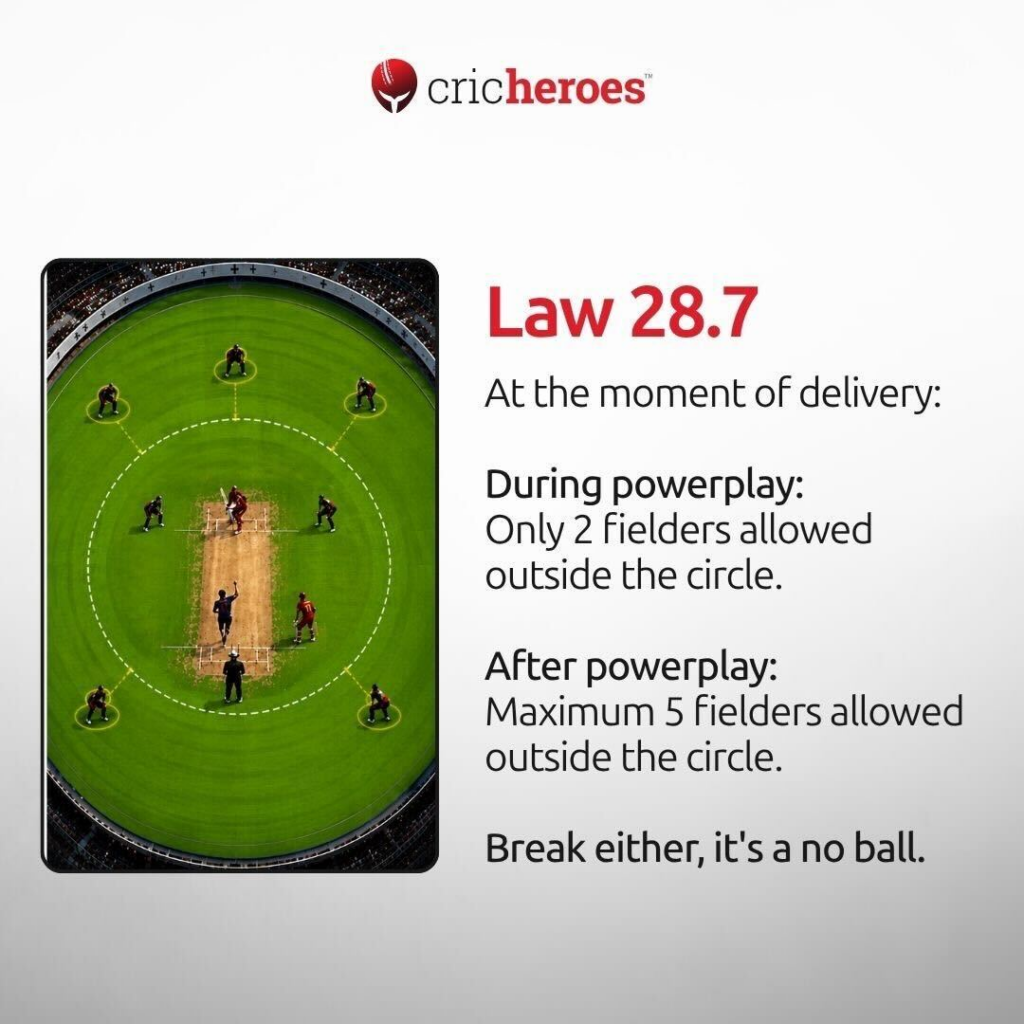
The restriction isn't about how many fielders go inside the circle. It's about how many are allowed outside it. Under the standard limited-overs conditions, during the powerplay only two fielders are permitted outside the fielding restriction area, and during the non-powerplay overs no more than five are allowed outside.
Once you flip your thinking to the outside count, playing short becomes easy. With nine players, you simply keep within the outside limit and arrange the rest however you like.
Simple example
You're fielding with nine in the powerplay. The rule only says a maximum of two can be outside the circle. So you place two out, and the remaining fielders, bowler and keeper sort themselves out inside. You are never forced to "fill" the circle.
Final verdict
Fielding rules count how many can stand outside the circle, not inside. Under standard limited-overs conditions that's two outside in the powerplay and five outside after it, though the powerplay length varies by format and league.
7. Bowling from behind the stumps
The situation
A bowler with a short run-up, or one trying something different, delivers the ball from well behind the stumps at his end rather than right up at the crease. The batting side cries no ball, saying he bowled from the wrong place.
Why players get confused
Players associate a legal delivery with the bowler arriving right up to the popping crease. Bowling from a long way back looks unusual, so it feels like it must be against the rules.
What most people believe
The myth: delivering from behind the stumps is automatically a no ball.
What the law actually says
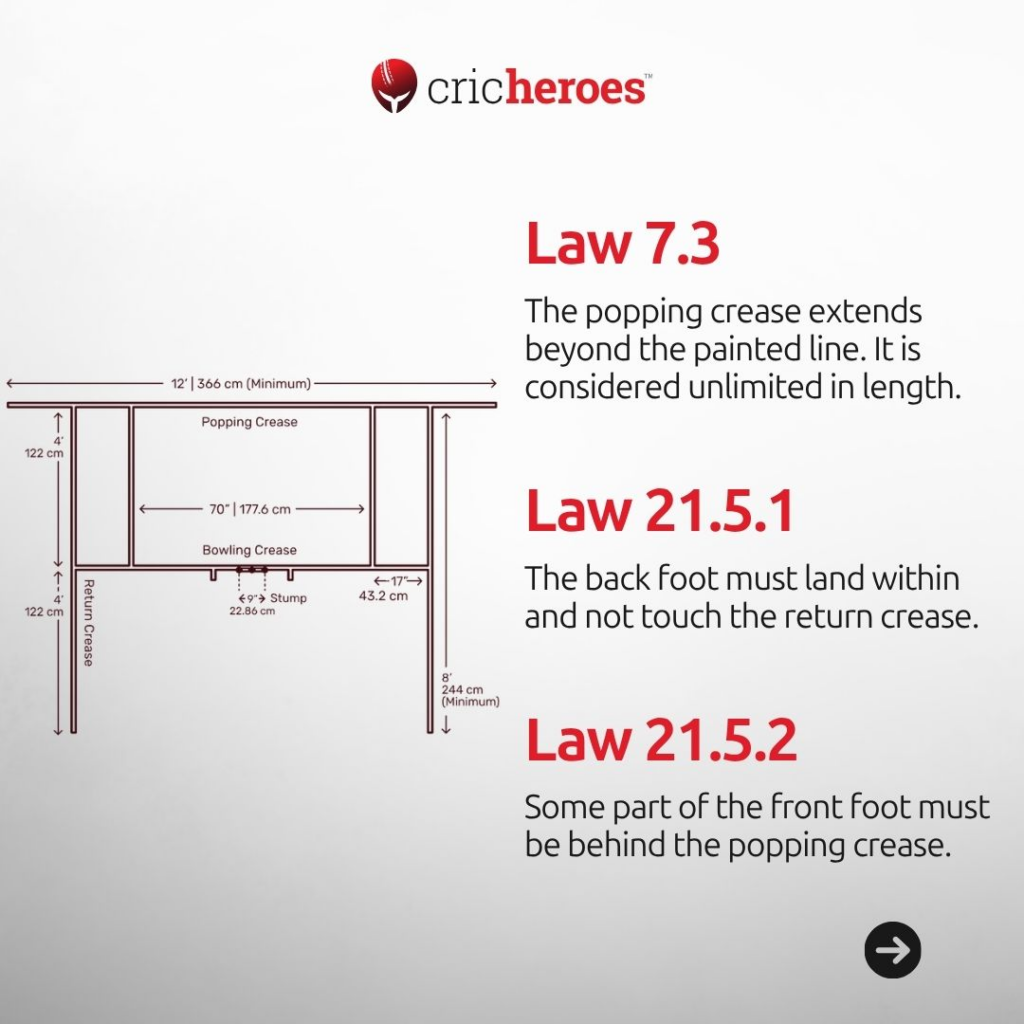
It's a perfectly fair delivery. The key is that the crease lines are treated as unlimited in length. Under Law 7, which sets out the creases, the popping crease line you see painted on the ground is deemed to extend all the way to the boundary. So any spot behind the stumps is still technically "behind" the popping crease.
That means a bowler can release the ball from way back, as long as two normal conditions are met: his back foot lands inside the return crease without touching it (Law 21.5.1), and some part of his front foot lands behind the popping crease (Law 21.5.2). Position along the pitch doesn't matter. Foot placement does.
Also read: How Many Creases Are There in Cricket? Explained with Types & Uses
Simple example
A spinner releases the ball a metre behind the stumps to get more loop. As long as his feet are legal, it's a fair ball, no matter how far back he let go.
Final verdict
Bowling from behind the stumps is legal. Only the usual foot rules apply.
8. Caught off the glove that wasn't holding the bat
The situation
A short ball jumps at the batter. He takes one hand off the bat to protect his face, and the ball strikes that loose glove and loops to a fielder, who takes the catch. Up goes the appeal.
Why players get confused
Everyone knows a catch off the glove can be out, because the glove is normally treated as part of the bat. The detail people miss is the condition attached to that: the glove only counts as the bat when it's actually holding it.
What most people believe
The myth: if the ball hits the glove and is caught, the batter is out, no matter what that hand was doing.
What the law actually says
For a catch to be valid, the ball has to touch the bat, or a hand or glove that is holding the bat (Law 33, which covers being caught). Under Law 5.7, a hand or glove is only treated as part of the bat while it's holding the bat. And Appendix A.12.1 makes the flip side clear: a hand, gloved or not, that is not holding the bat is treated as part of the batter's person, not the bat.
So if the hand was off the handle when the ball struck the glove, the ball effectively hit the batter's body. You can't be caught off your own body. It's not out.
Simple example
A batter lets go with his bottom hand to fend a bouncer away from his head. The ball hits that free glove and is caught at short leg. Because the glove wasn't holding the bat, it counts as the body, so the catch doesn't stand. Not out.

Final verdict
A glove counts as the bat only while it's holding the bat. If it isn't, a catch off it is not out.
9. Changing the wicketkeeper without informing the umpire
The situation
Mid-innings, a team decides to swap their wicketkeeper. The regular keeper hands the gloves to a teammate without a word to the umpire, and play carries on. Someone shouts that the next ball must be a no ball.
Why players get confused
There's a general sense that you have to inform the umpire about changes, and players blur that good practice into a hard penalty. They assume a quiet keeper swap breaks a rule that triggers a no ball.
What most people believe
The myth: changing the keeper, mid-over or between overs, without informing the umpire is a no ball.
What the law actually says
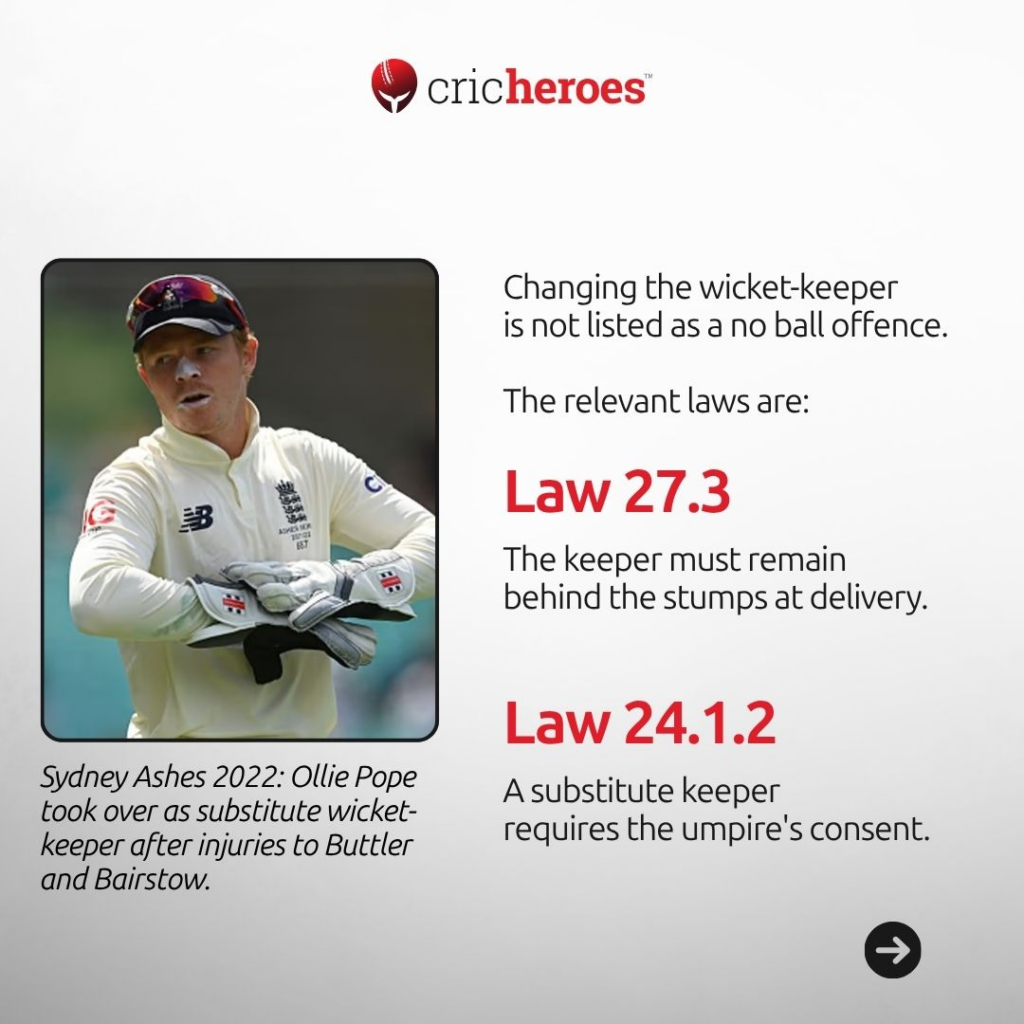
It isn't. Telling the umpire is courteous and sensible, but a keeper change doesn't appear on the list of things that cause a no ball. Law 21.11 sets out exactly what triggers a no ball signal, and changing the person keeping wicket is not on it.
The only keeper-related no ball is about position, not identity. Under Law 27.3, the keeper must be wholly behind the stumps at the moment of delivery. Separately, if a substitute who isn't in the original eleven wants to keep, that needs the umpires' consent under Law 24 (Substitutes), but even forgetting to ask doesn't turn it into a no ball.
Simple example
Your keeper's finger is sore, so a teammate takes the gloves between overs and nobody tells the umpire. The next ball is fair. The only thing that would make it a no ball is if the new keeper was standing in front of the stumps at delivery.
Final verdict
Changing the keeper is legal even without informing the umpire. The only catch is that the keeper must stay behind the stumps at delivery.
10. The ball that bounces twice
The situation
A tired bowler drops one short and it bounces twice on its way down the pitch. The batter blocks it. There's instant confusion over whether two bounces always means a no ball.
Why players get confused
The rule changed in recent years, and a lot of players are working from the old version in their heads. They remember "double bounce equals no ball" and apply it without checking where those bounces happen.
What most people believe
The myth: any ball that bounces twice before reaching the batter is automatically a no ball.
What the law actually says
Not always. Under Law 21.7, the umpire calls a no ball only if the ball bounces more than once before it reaches the popping crease. The location of the second bounce is what decides it.
So if the ball pitches once on the wicket and the second bounce lands on or behind the popping crease line, it has only bounced once before reaching the line. That's a fair delivery. It's only a no ball if that second bounce happens on the pitch before the ball crosses the popping crease.
Simple example
A slow bowler's delivery pitches halfway, then bounces a second time right on the batting crease as it reaches him. Since the second bounce was on the line, not before it, it's a fair ball. But if it had bobbled twice in the middle of the pitch, well short of the crease, that would be a no ball.

Final verdict
Two bounces are fine as long as the second one lands on or after the popping crease. A second bounce before the crease is a no ball.
Quick summary table
| Situation | Verdict |
| Bowler doesn't announce his side | Legal |
| Bowler changes side mid-over without informing | No ball |
| Keeper makes a big, undeclared move before delivery | Dead ball (re-bowl) |
| Keeper makes small, natural adjustments | Legal |
| Back foot touches the return crease line | No ball |
| Full toss above the waist at normal stance | No ball |
| Three or more fielders behind the popping crease on the leg side | No ball |
| Six or more fielders on the leg side (limited-overs conditions) | No ball |
| More than two fielders outside the circle in the powerplay (limited-overs conditions) | No ball |
| Bowling from behind the stumps with legal feet | Legal |
| Catch off a glove that was holding the bat | Out |
| Catch off a glove that was not holding the bat | Not out |
| Keeper changed without informing the umpire | Legal |
| Keeper in front of the stumps at delivery | No ball |
| Second bounce before the popping crease | No ball |
| Second bounce on or after the popping crease | Legal |
Final thoughts
Most arguments on a cricket ground aren't really about who's right. They're about nobody being sure. Once everyone actually understands these situations, the shouting stops, the game moves faster, and matches feel fairer for both sides.
You don't need to memorise the law numbers. You just need to know what really happens when the ball hits a loose glove, when a keeper creeps up, or when a full toss comes through high. Keep these ten in your back pocket and you'll be the one who settles the call calmly while everyone else is still arguing.
Bookmark this guide, and share it with your teammates and your umpires before your next match. The more people who know these, the fewer minutes you'll lose to confusion.
We'll keep simplifying the game, one confusing law at a time.

SEO All-Rounder
Manan Joshi is a cricket writer & content strategist at CricHeroes who covers the game from the ground up — rules, technique, player development, grassroots tournaments, and IPL. His writing is shaped by real insights drawn from millions of live-scored matches, giving him a perspective on recreational cricket that few writers have access to. CricHeroes is the #1 Cricket Scoring App globally, with 4 crore+ cricketers using it to live score their local matches and tournaments. For cricket apparel and accessories, visit the CricHeroes Store.