

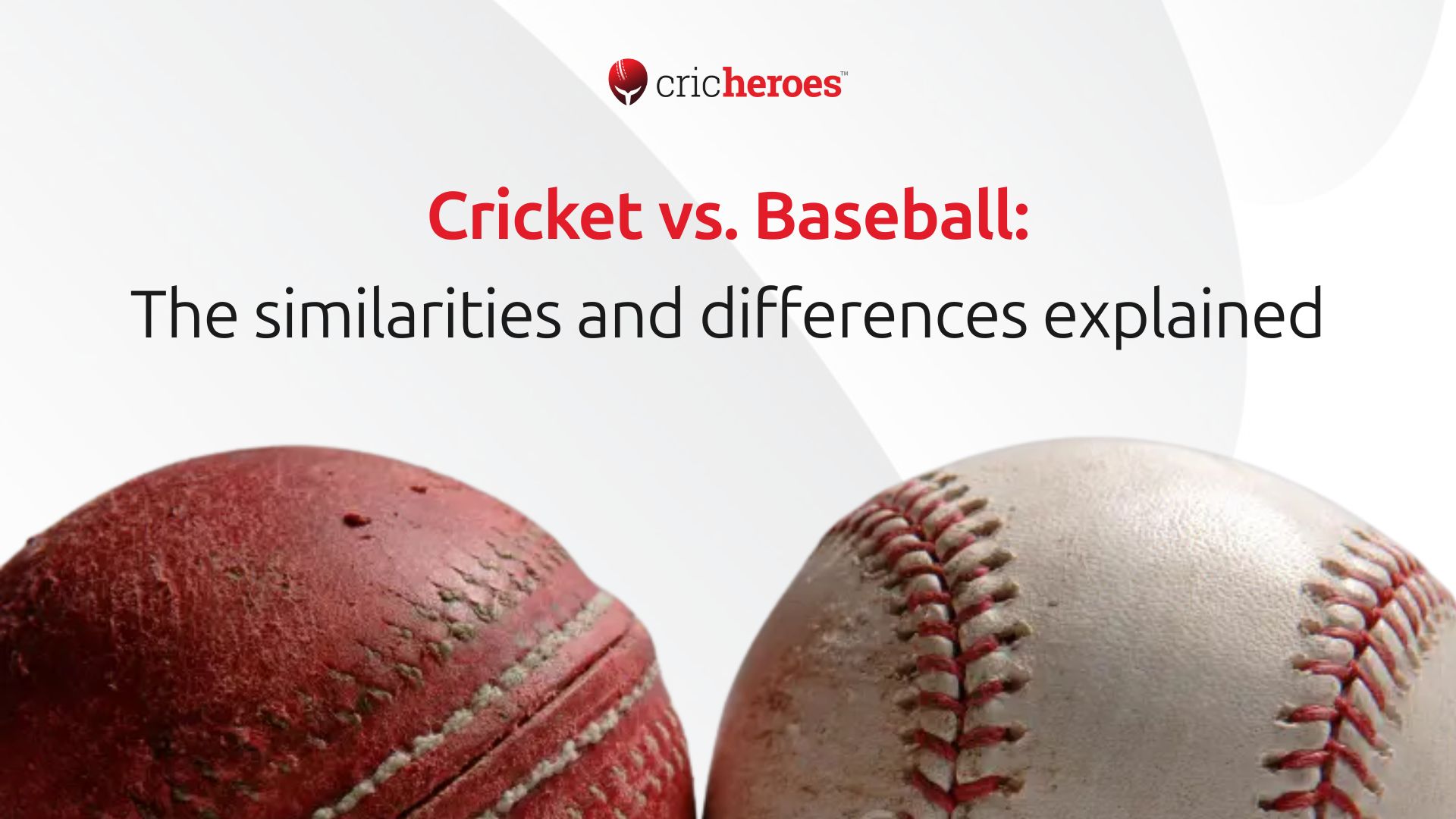


Cricket and baseball share bats, balls, and loyal fans. But anyone who’s played both knows they’re worlds apart. The confusion is common — which one is tougher? Faster? More strategic?
It matters because each sport tells a story of discipline, teamwork, and national pride.
This guide clears up every doubt about cricket vs baseball — from history and rules to skills, structure, and culture.
Origins and evolution
Cricket began in 16th-century England. Farmers and shepherds first played it on open grass fields.
When the British Empire expanded, the game spread across continents — India, Australia, the Caribbean, South Africa, and beyond. By 1877, England and Australia played the first official Test.
Baseball took shape in 18th-century North America. It grew out of European bat-and-ball games like rounders but soon developed its own rhythm. By the late 1800s, professional leagues were forming and the sport became “America’s pastime.”
Key differences in evolution:
- Cricket developed through patience and strategy.
- Baseball evolved through speed and showmanship.
- Both reflect their cultures: one values endurance, the other action.
Field, equipment, and team setup
Both sports need space and precision, but the layout changes everything.
Field layout
- Cricket: Oval ground with a 22-yard central pitch. Play happens in every direction.
- Baseball: Diamond-shaped field focused forward from home plate. Movement follows four bases.
Equipment overview
| Feature | Cricket | Baseball |
| Bat | Flat-faced willow blade | Round wooden barrel |
| Ball | Hard leather, red or white, raised seam | White leather, red stitching |
| Gloves | Only wicket-keeper uses gloves | All fielders wear gloves |
| Helmet & Pads | For batters and close fielders | For batters and catcher |
Team structure
- Cricket: 11 players, most rotate roles (bat, bowl, field).
- Baseball: 9 players, each with a fixed position.
Game format and rules
Cricket’s beauty lies in its variety. Baseball’s charm lies in its simplicity.
Cricket formats
- Test Cricket – 5 days, two innings per team.
- One Day International (ODI) – 50 overs per side.
- T20 Cricket – 20 overs per side, usually done in 3–4 hours.
Baseball format
- One standard format: nine innings per game.
- Each team bats until three outs per inning.
How they score
- Cricket: Runs from hitting the ball and running between wickets or reaching the boundary (4 or 6).
- Baseball: Runs scored when a batter circles all four bases and reaches home plate.
Getting out
- Cricket: Bowled, caught, LBW, run-out, stumped.
- Baseball: Strikeout, fly-out, tag-out, or force-out.
Match duration:
- A T20 game lasts as long as one baseball match.
- Test matches can exceed 30 hours of play — an ultimate test of patience.
Summary:
Cricket stretches time and strategy. Baseball compresses action and reaction. Both demand focus and teamwork.
Skill sets and player roles
Every cricketer must adapt. Every baseball player must specialize.
Cricket skills
- Batting: Shot selection, footwork, and timing matter more than brute power.
- Bowling: Includes fast bowling, swing, seam, spin, and variations in pace.
- Fielding: Sharp reflexes, catching skill, and awareness of angles across 360 degrees.
Baseball skills
- Pitching: Precision control, varied speed, and movement are everything.
- Batting: Split-second decision between swing or hold.
- Fielding: Short sprints, glove work, and quick throws to bases.
Role difference
- Cricket: Many all-rounders — players bat and bowl.
- Baseball: Defined positions — pitcher, catcher, shortstop, outfielders.
Example
A cricket bowler adjusting line and length for different batters compares to a pitcher switching between fastballs and curveballs. The skill philosophies are parallel, though the executions differ.
Popularity, geography, and fan culture
Cricket rules much of the world. Baseball dominates the Americas and parts of East Asia.
Both attract millions, yet their strongholds differ.
Where cricket leads
- India, Pakistan, Sri Lanka, Bangladesh
- England, Australia, South Africa, New Zealand
- West Indies and growing scenes in the USA and UAE
Where baseball shines
- United States, Canada, Mexico
- Japan, South Korea, Dominican Republic, Cuba, Venezuela
Cricket’s Fan Base: About 2.5 billion fans worldwide.
Baseball’s Fan Base: Roughly 500 million fans.
Cultural difference
- Cricket: A social event. Families gather for hours or days. Test matches have become tradition.
- Baseball: A stadium spectacle. Quick snacks, music, chants, and instant stats on big screens.
Cricket celebrates patience and narrative. Baseball celebrates moments. Each offers its own rhythm — one steady, one electric.
Similarities between cricket and baseball
Despite their differences, the DNA is shared.
Common elements
- Both are bat-and-ball sports.
- Both revolve around runs, outs, and innings.
- Both rely on team coordination and strategic field placements.
- Both reward hand-eye coordination and mental composure.
Shared spirit
- A single catch can change everything.
- A clean strike feels the same — pure satisfaction.
- Both sports teach respect for the game and for teammates.
For fans who enjoy tactics and timing, either game can be home.
Key differences at a glance
| Category | Cricket | Baseball |
| Team Size | 11 players | 9 players |
| Field Shape | Oval | Diamond |
| Game Length | 20 overs – 5 days | ~3 hours |
| Scoring Method | Runs between wickets or boundaries | Runs after circling bases |
| Ball Delivery | Bowled after bounce | Pitched in air |
| Protective Gear | Pads, gloves, helmet for batters | Gloves for all fielders |
| Roles | All-rounders common | Roles specialised |
| Global Reach | Asia, UK, Oceania | Americas, Japan, Korea |
A glance shows how each game evolved to suit its fans and conditions.
Which sport might suit you?
Choosing between cricket and baseball often depends on personality and environment.
Pick Cricket if you love:
- Strategic planning and long contests
- Technical batting and swing bowling
- Team rotations and multi-role play
- Patience and tactical depth
Pick Baseball if you enjoy:
- Quick decisions and constant action
- Shorter, high-energy games
- Defined roles and specialised training
- Stadium atmosphere and showmanship
Both sports reward dedication and respect for skill. Many grassroots players who start with cricket later admire baseball’s precision, and vice versa.
The fan and player experience
Cricket:
- Matches become festivals — music, drums, flags, and family picnics.
- Street or “gully” cricket keeps the sport alive every evening.
- Local scorers, organisers, and umpires record every delivery on apps like CricHeroes, turning effort into legacy.
Baseball:
- Stadium crowds rise with every pitch.
- Statistics flash on digital boards.
- Even local minor leagues use scorecards to track every at-bat.
Both experiences celebrate the joy of participation. Every single run or strike counts.
Future trends and global growth
Cricket and baseball are expanding beyond their traditional borders.
Cricket’s growth
- T20 Leagues: IPL, BBL, PSL, and The Hundred attract global audiences.
- T10 and Franchise Cricket: Shorter, faster versions appealing to new fans.
- USA Cricket: Major League Cricket (MLC) has started bridging two sporting worlds.
Baseball’s growth
- World Baseball Classic: Nations from Asia, Europe, and Latin America compete.
- Technology and Analytics: Data-driven strategies similar to cricket’s “Hawk-Eye” systems.
- Emerging Markets: Youth leagues in Africa and Europe gaining traction.
Both sports embrace data and innovation. The next decade will blur boundaries as players, coaches, and fans connect across formats.
Conclusion
Cricket and baseball started as siblings but grew into distinct identities. Cricket values time, patience, and tactical shifts. Baseball thrives on rhythm, precision, and pace.
Both demand courage, focus, and teamwork. Whether you swing a bat in a park or chase a boundary on a Sunday ground, every effort counts.
Your cricket matters — from gully games to local tournaments. Every score, every wicket, every catch adds to the global story of the sport.
FAQ
1. Which came first — cricket or baseball?
Cricket originated in 16th-century England; baseball evolved later in 18th-century America.
2. Which is harder, cricket or baseball?
Both are tough in different ways. Cricket tests endurance; baseball tests split-second reaction.
3. Why do cricketers not wear gloves like baseball players?
Only wicket-keepers need gloves; other fielders rely on bare hands for better control.
4. Can baseball players succeed in cricket?
Some skills transfer, but cricket’s bounce, swing, and shot variety take time to learn.
5. How long does a cricket match last compared to baseball?
A T20 lasts about 3 hours; a Test can last 5 days. Baseball games average 3 hours.
6. Where is baseball more popular than cricket?
The USA, Japan, and the Caribbean are baseball strongholds.
7. What is harder — hitting a cricket ball or a baseball?
Both require timing. A 90 mph pitch and a 145 km/h delivery challenge even pros.
8. How do scoring systems differ?
Cricket scores through runs and boundaries; baseball scores when runners reach home plate.
9. Is cricket growing in the USA?
Yes. Leagues like MLC and youth academies are helping cricket gain attention in North America.

I am Manan Joshi , SEO All-Rounder at CricHeroes.
CricHeroes is the ultimate Cricket Scoring App and the world’s only true Cricket Network. With more than 4 crore+ registered cricketers using CricHeroes to Live Cricket Scores for their local cricket matches and tournaments, CricHeroes is already the #1 Cricket Scoring App Globally!
We also proudly present “CricHeroes Store” by CricHeroes, a dedicated shop for cricket apparel and accessories, helping players gear up for their game.