

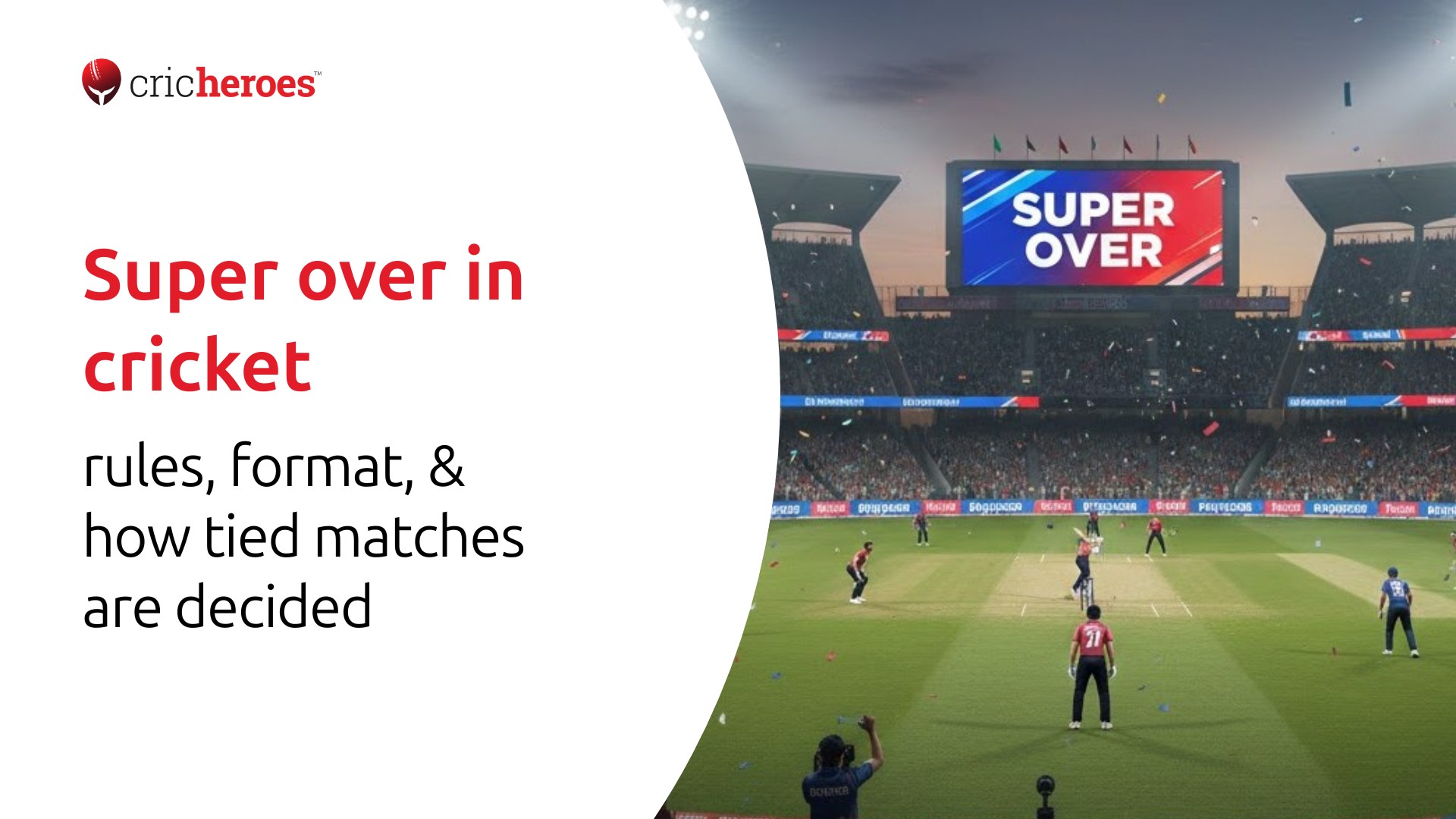


A super over in cricket is the official one-over eliminator used to decide a winner when a limited-overs match ends in a tie. The rules of super over apply in Twenty20 cricket and selected One Day International (ODI) matches where a result is required.
This rule exists to avoid shared results in high-stakes games. It compresses pressure into six balls per side and tests batting order significance, bowling changes, and nerve control paramount moments.
- The super over is used only after equal scores
- Each team plays one additional over
- The team scoring the most runs wins
The super over has become one of the defining features of modern limited-overs cricket.
Also read: Types of cricket matches
What is a Super Over in Cricket?
A super over in cricket is a tie-breaking method used when a limited-overs cricket match ends in a tie. Under the rules of super over, each team plays one over of six legal balls, and the team scoring the most runs is declared the winner.
The method is used mainly in Twenty20 cricket and knockout matches in ODI tournaments. It ensures a clear match result without relying on points or shared outcomes.
- It resolves tied cricket matches quickly
- It uses real match skills, not artificial tests
- It fits modern broadcast and tournament needs
A Super Over is now the ICC-approved standard solution for tied limited-overs matches.
History and evolution of the super over in cricket
Cricket authorities introduced the Super Over after dissatisfaction with earlier tie-breaking systems. Before 2008, cricket relied on bowl-outs, which many felt did not reflect a full cricket contest.
- Bowl-outs removed batting entirely
- Results felt disconnected from the match flow
- Fans and players wanted a fairer method
The super over was first used in 2008 during a Twenty20 international match between West Indies and New Zealand on 26 December 2008. Chris Gayle scored 25 runs, setting the tone for how dramatic this format could be.
Also read: Mastering Cricket Overs
Previous iterations and changes: From bowl outs to super overs
Bowl-outs decided matches by hitting unguarded stumps. This method ignored batting skill and match momentum.
- Only bowlers took part.
- Batters had no influence
- The situation lost its match context.
The super over replaced bowl-outs by keeping the contest within cricket’s normal structure, using batters, bowlers, and fielding restrictions similar to a final over.
Rules and procedure of a super over in cricket
The International Cricket Council (ICC) defines Super Over rules under the Standard Twenty20 International Match Playing Conditions.
Each super over follows a fixed process designed to keep both teams on equal footing.
Basic format and procedure
A super over begins immediately after a tied match, following a short break.
- Each team faces one over of six legal balls
- Teams nominate three batters and one bowler
- The innings ends after two wickets fall
This format ensures the over stays short while still involving tactical choices.
Who bats first in a super over?
The team that batted second in the main match bats first in the super over. This removes the chasing advantage carried from the original innings.
- Teams reverse the batting order from the main match.
- The bowling team chooses the bowling end
- A spare ball is selected
This rule keeps the contest balanced.
Also read: Cricket Rules and Regulations
Scoring
Runs scored in a super over decide the winner, but they do not count toward match or career statistics.
- Officials record Super Over runs independently from the main innings.
- Wickets do not affect player averages
- The super over is not part of the main innings
This separation keeps player records clean.
Want to score Super Overs the right way?
CricHeores Cricket Scoring helps you record Super Over runs in a way that keeps main innings and player statistics accurate.
👉 Score Your Match on CricHeores
Rules for tied super overs
If a Super Over ends in a tie, teams play another Super Over under current ICC rules.
- Batting order reverses again
- Dismissed batters cannot bat again
- Bowlers cannot bowl consecutive super overs
This continues until a winner is decided.
Variations and exceptions by league or tournament
Some leagues adjust super over rules to suit scheduling or format needs.
- Group-stage matches may allow tied results
- Knockout matches require a winner
- Bilateral series follow repeated super over rules
Tournament playing conditions always take priority.
Big Bash League’s unique twist
During the 2014–15 season, the Big Bash League allowed all ten wickets to be used in a super over.
- Teams could bat until all out
- The format increased scoring range
- The rule was later dropped
It remains one of the most unusual super over experiments.
When is a super over not used?
A super over is not mandatory in every tied match.
- Some league matches allow ties
- Weather-reduced games may avoid super overs
- Duckworth–Lewis method outcomes can override
The decision depends on tournament regulations.
The five-minute interval rule
Each super over must start after a five-minute interval.
- Teams use the break for nominations
- Field settings are prepared
- Broadcast coordination occurs
This rule applies between every repeated super over.
Strategy in a super over
Strategy in a Super Over is compressed and unforgiving—one mistake can end the innings.
- Teams select aggressive batters
- Captains prefer death-over bowlers
- Field restriction nuances matter
Risk reward calculation becomes the core decision-making factor.
Controversies and criticisms
The super over has faced criticism for oversimplifying long matches.
- One over may not reflect overall dominance
- Luck can play a larger role
- Pressure magnifies errors
Despite this, it remains widely used.
Boundary count rule controversy
The 2019 Cricket World Cup Final between England and New Zealand ended with a tied super over. England won using the boundary count-back rule.
- Fans questioned fairness
- Former players criticized the outcome
- The ICC later removed the rule
Repeated super overs replaced boundary counts after October 2019.
Impact and implications
The super over affects players, captains, and fans in different ways.
Implications for players, captains, and fans
A super over tests skill under pressure more than endurance.
- Players face instant judgment
- Captains carry selection responsibility
- Fans experience peak tension
It has reshaped how teams prepare for close finishes.
What happens to player stats?
Super over performances do not affect official records.
- The system excludes runs from the totals.
- Wickets do not count
- Career averages remain unchanged
This keeps the super over separate from regulation play.
Memorable super overs in cricket history
Several super overs have shaped modern cricket memory.
- 2019 Cricket World Cup Final
- 2020 Indian Premier League double super over
- Afghanistan vs India in 2024
- Netherlands vs Nepal triple super over on 16 June 2025
These matches show how far the format has stretched.
International matches decided by a super over
Super overs have decided matches across formats and genders.
Men’s One Day International
The 2019 World Cup Final remains the only ODI final decided by a super over.
Men’s Twenty20 International
The first-ever super over came in 2008, and dozens have followed since.
Women’s One-Day International
In women’s cricket, teams adopted the format for knockout and high-profile matches.
Women’s Twenty20 International
Super overs in women’s T20Is have grown since 2020.
Future of the super over
The super over is likely to remain part of limited-overs cricket.
- Repeated super overs are now standard
- The ICC has removed the boundary count rule.
- Data-driven strategy continues to grow
Debate between fairness and spectacle will continue.
Conclusion
A super over is the ICC-approved method for resolving tied limited-overs matches. Under the rules of super over, each team plays one over, and the higher score wins.
The format replaced bowl-outs, survived major controversy, and became central to modern cricket finishes. While debate continues, the super over remains the clearest and fastest way to decide tied matches.
FAQs
What is a super over in cricket?
A Super Over is a one-over eliminator that decides the winner when a limited-overs match ends in a tie.
What are the rules of super over?
The rules of super over state that each team plays one over of six balls, using three nominated batters, and the team scoring more runs wins.
Who bats first in a super over?
The team that batted second in the main match bats first in the super over under ICC playing conditions.
How many players can bat in a super over?
Each team can use only three batters in a super over, and the innings ends when two wickets fall.
What happens if a super over is tied?
If a Super Over ends in a tie, teams play additional Super Overs until a winner is decided in knockout matches and bilateral series.
Do super over runs count in player statistics?
No, super over runs and wickets do not count in official career records because the super over is separate from the match innings.
Is a super over used in ODI matches?
Yes, teams can use a Super Over in One Day International (ODI) matches, mainly in knockout games or finals that require a result.
When is a super over not used?
Some league-stage matches do not use a Super Over because tournament rules allow the match to remain tied.
What was the boundary count rule in super overs?
The boundary count rule awarded victory to the team with more boundaries if both the match and the Super Over ended in a tie, but the ICC removed the rule after October 2019.
Which match had the most famous super over?
The most famous super over happened in the 2019 Cricket World Cup Final, when England vs New Zealand ended in a tied match and a tied super over.

I am Manan Joshi , SEO All-Rounder at CricHeroes.
CricHeroes is the ultimate Cricket Scoring App and the world’s only true Cricket Network. With more than 4 crore+ registered cricketers using CricHeroes to Live Cricket Scores for their local cricket matches and tournaments, CricHeroes is already the #1 Cricket Scoring App Globally!
We also proudly present “CricHeroes Store” by CricHeroes, a dedicated shop for cricket apparel and accessories, helping players gear up for their game.